
Abs Are Made in the Kitchen. Half of That Is Wrong
Diet decides whether you can see your abs. It does not decide whether there is anything worth seeing. Here is what the measured data says about training them.
Written while building GETSIXPACK — a training log that scores the session against your range and calls the next load.
Every gym has this line in it, and it is usually deployed as an argument against something. Somebody is doing crunches, somebody else says abs are made in the kitchen, and the crunches stop.
The line has survived for twenty years because the first half of it is true and easy to check. The trouble is what people hear in the second half — that training the abdominal wall is a waste of a set — and that half is wrong in a way you can measure.
The half that is true
You cannot train the layer off. This is not a matter of opinion and it has been tested directly.
Vispute and colleagues took twenty-four sedentary volunteers and split them. One group did seven abdominal exercises, two sets of ten, five days a week for six weeks. The other did nothing. Diet was held constant in both.
After six weeks the training group had changed their body weight by nothing, their body fat percentage by nothing, their android fat by nothing, their abdominal circumference by nothing, and their abdominal skinfold thicknesses by nothing.
So the deficit is the only thing that removes what is on top, and everything in the twelve-week plan is about running that deficit without spending muscle to do it. Nothing on this page changes that.
Except that “never” turns out to be “hardly ever”
Gym lore states spot reduction as a flat impossibility. The literature is slightly less tidy, and the untidiness is worth two minutes because it is where most of the arguing happens.
Kostek and colleagues put 104 people through twelve weeks of supervised resistance training — of one arm only, with the other arm as a within-person control. Then they measured subcutaneous fat two ways. Skinfold callipers said the trained arm had lost fat and the untrained one had not, in the men. MRI, scanning the whole upper arm rather than one pinch of it, said the loss was general and there was no difference between the arms in anybody. Same intervention, same people, two instruments, two answers.
Then, in 2023, Brobakken and colleagues ran the version nobody had run: an aerobic trial with the energy expenditure actually matched between the groups. Sixteen overweight men, ten weeks, four days a week. One group ran on a treadmill for 45 minutes. The other ran for 27 minutes and spent the rest of the session on torso rotation and abdominal crunches at 30 to 40% of their maximum, for the same total energy cost.
Take that at face value, and then look at what it is worth. Six hundred and ninety-seven grams of trunk fat, over ten weeks, in sixteen men, bought with about forty sessions. The same men lost more than a kilogram of total fat either way. A local effect that exists and is that small is not a training decision — it is a footnote to the deficit.
So the honest version is this: the fat you can see is decided by the deficit, plus or minus an amount too small to plan a programme around.
The half that is wrong: there is a muscle under there
Here is the thing the line quietly denies. The rectus abdominis is a muscle. It has a nerve supply, a blood supply and a fibre distribution, and it gets bigger when you load it — which means that at any given body fat, how much of it there is decides what you see.
The cleanest demonstration of this is not a training study. It is a scan.
Sanchis-Moysi and colleagues put eight professional male tennis players and six non-active men through an MRI and measured the volume of the rectus abdominis. After adjusting for age, muscle length and BMI, the players’ rectus abdominis was 58% larger.
That number on its own could be explained away as athletes being athletic. The part that cannot is what they found inside each player. The non-dominant side of the muscle was 35% larger than the dominant side — in the same person, on the same diet, under the same hormones — and the asymmetry increased steadily the further down the muscle they looked, from the first lumbar disc to the pubic symphysis. In the non-active controls there was no side-to-side difference at all.

Be careful about how far that carries. Eight players and six controls is a small study, it is cross-sectional rather than a training trial, and nobody made those men do crunches. It does not tell you that any particular exercise builds abs. What it establishes is the thing the gym line denies flat: the abdominal wall is a muscle that gets substantially bigger under load, and the pattern follows the loading.
The same group later found the matching result one layer out. In tennis players the obliques and transversus were 18% larger on the non-dominant side and the hypertrophy was confined to the upper segments; in professional footballers the same muscles were larger on both sides evenly. Two sports, two shapes, the same muscles.
Why this decides what you see
Two lifters arrive at 12% body fat. One has a visible, blocky abdominal wall. The other has a flat stomach and not much else.
Part of that is where their fat sits, which is not a training decision and never will be. The other part is how much muscle is under it — and that part is a hypertrophy problem, which means it is the ordinary kind of problem with the ordinary kind of solution.
It is also the half you can still work on when the deficit is already as large as it should be. There is a floor on how fast you can lose fat without paying for it in muscle. There is no equivalent floor on training the abdominals properly; that is just a slot in the week nobody was using.
So train them like a muscle
Nothing exotic. The same rules as everything else in the programme.
Schoenfeld and colleagues’ meta-regression of training volume found a graded dose-response across 34 treatment groups: each additional weekly set was worth about 0.37% more muscle, and the studies’ higher-volume conditions beat their lower-volume ones by 3.9%. There is no reason the abdominal wall is exempt from that and no evidence that it is.
- Twice a week, three or four hard sets. Not a finisher you do when there is time left. A slot, with a target.
- Pick movements that can carry load. Weighted or cable crunches, hanging leg raises with a dumbbell between the feet, ab wheel, loaded carries. If the resistance cannot go up next month, the exercise cannot progress.
- Work in a rep range and write it down. Eight to fifteen. Clear the top of the range on every set, then add weight.
- Take them near failure, like anything else. Two or three reps in reserve on the working sets.
- Stop counting to a hundred. High-repetition bodyweight work is endurance training — and abdominal endurance is precisely the one thing Vispute's group significantly improved.
That last point is the one worth sitting with. Vispute’s trial is quoted everywhere as proof that ab training does nothing. It is proof that ab training does not remove abdominal fat. In the same paragraph of the same paper, the training group significantly improved abdominal muscular endurance. The training worked. It simply did the thing it was actually a stimulus for, which was not the thing it was being sold for.
What the line should say
“Abs are made in the kitchen” is the right answer to the wrong question. It answers why can’t I see them, and the answer is correct — there is a layer on top and only a deficit removes it.
The question it does not answer is what will be there when the layer goes, and that one has a completely different answer, which is: whatever you built. A cut is a reveal. It uncovers the muscle you have and not a gram more, and that is as true of the abdominal wall as it is of your arms.
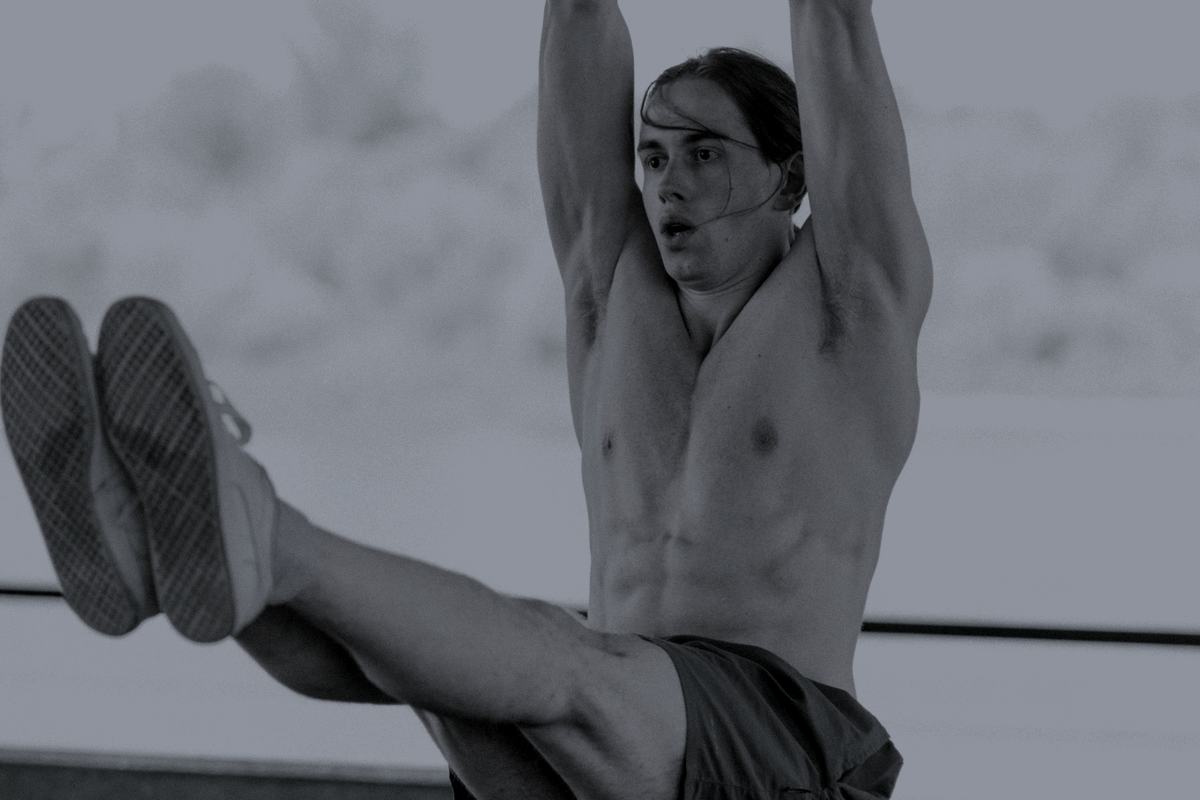
So run both. The deficit decides when you can see the abdominal wall; the training decides what is there when you do. If you want the arithmetic on the first half — how many weeks between you and the body fat where it starts showing — that calculation takes about two minutes and it is worth doing before you start rather than in week six.
Where this comes from
The six-week abdominal training trial — no change in body weight, body fat percentage, android fat, abdominal circumference or abdominal skinfolds, and a significant improvement in abdominal muscular endurance: Vispute, Smith, LeCheminant and Hurley, Journal of Strength and Conditioning Research, 2011 (doi:10.1519/JSC.0b013e3181fb4a46).
The single-arm training study where skinfold callipers and MRI disagreed about whether spot reduction had happened: Kostek, Pescatello, Seip, Angelopoulos and colleagues, Medicine & Science in Sports & Exercise, 2007 (doi:10.1249/mss.0b0138058a5cb).
The energy-expenditure-matched abdominal trial that found a local effect and put a number on it: Brobakken, Krogsaeter, Helgerud and Wang, Physiological Reports, 2023 (doi:10.14814/phy2.15853).
Rectus abdominis volume in professional tennis players, and the 35% asymmetry within each player: Sanchis-Moysi, Idoate, Dorado, Alayón and Calbet, PLoS One, 2010 (doi:10.1371/journal.pone.0015858). The sport-specific pattern in the lateral abdominal wall — asymmetric in tennis, symmetric in football: Sanchis-Moysi, Idoate, Izquierdo and Calbet, Sports Biomechanics, 2013 (doi:10.1080/14763141.2012.725087).
The dose-response between weekly sets and muscle growth: Schoenfeld, Ogborn and Krieger, Journal of Sports Sciences, 2017 (doi:10.1080/02640414.2016.1210197).
Questions people ask about this
- Can you get visible abs without training them directly?
- Yes, if you are lean enough and you carry enough abdominal muscle already. What direct training changes is how much there is to see at any given body fat — and it is the only half of the equation you can still work on once the deficit is already as large as it should be.
- How often should I train abs?
- Twice a week, three or four hard sets each time, is enough if the load goes up. There is nothing special about the abdominal wall that calls for a different frequency from the one you would run on any other muscle group, and the pooled data on training volume says each extra weekly set buys about 0.37% more muscle.
- If spot reduction does not work, why does the idea keep coming back?
- Because it partly does, in a small way, and because it depends which instrument you use. One trial of single-arm training found the trained arm lost more fat when measured with skinfold callipers and no such thing when measured with MRI. A better-designed abdominal trial found the local effect was real and worth 697 g of trunk fat over ten weeks. The idea survives because it is not quite false; it is just far too small to plan around.
- Do I need to use weight for ab exercises?
- If you want the muscle to get bigger, yes. The rectus abdominis responds to progressive load the way every other muscle does. Weighted crunches, cable crunches, hanging leg raises with a dumbbell between the feet, loaded carries — anything where the resistance can go up next month. High-repetition bodyweight work trains endurance, which is a real adaptation and not the one you are after.