
The Body Fat Where Abs Show — And Why It Isn't One Number
Two people at identical body fat can look nothing alike. Here is what the measured data actually says, why your number has a wide error bar, and what to do.
Written while building GETSIXPACK — a training log that scores the session against your range and calls the next load.
Two lifters get a DXA scan on the same afternoon. Both come back at 14% body fat. One has a visible four-pack in normal light. The other has a flat stomach and nothing else.
Neither machine is broken and neither of them is doing anything wrong. Body fat percentage is a single number describing a distribution, and the distribution is what you actually see in the mirror.
Nobody has ever measured this, and that matters
Search for the body fat percentage at which abs appear and you will get a confident answer, usually 10 to 12% for men and 18 to 20% for women, sourced to nothing.
Here is the honest position: no trial has ever measured abdominal definition against body fat percentage. There is no study to cite because nobody has run one. What exists is a set of documented case studies of very lean people, plus population data on what body fat percentages are normal, and the range people quote is triangulated from those and from coaching experience.
The case studies are worth knowing because they are the only hard numbers in this whole conversation.
Kistler and colleagues tracked a natural bodybuilder through a 26-week contest preparation with monthly DXA scans. He went from 88.6 kg at 17.5% body fat to 73.3 kg at 7.4%. Rossow and colleagues followed a different drug-free competitor over a full year: 14.8% body fat six months out, 4.5% on stage, 14.6% again six months after.
Neither study rated how visible anybody’s abdominal wall was — that is not what either was measuring. What they give you is the span a physique actually travels. Rossow’s athlete covered 10.3 percentage points, from an off-season 14.8% to a stage-ready 4.5% and back to 14.6%, with the same abdominal muscles underneath the whole way. The visible difference across that span is enormous, and none of it is muscle.
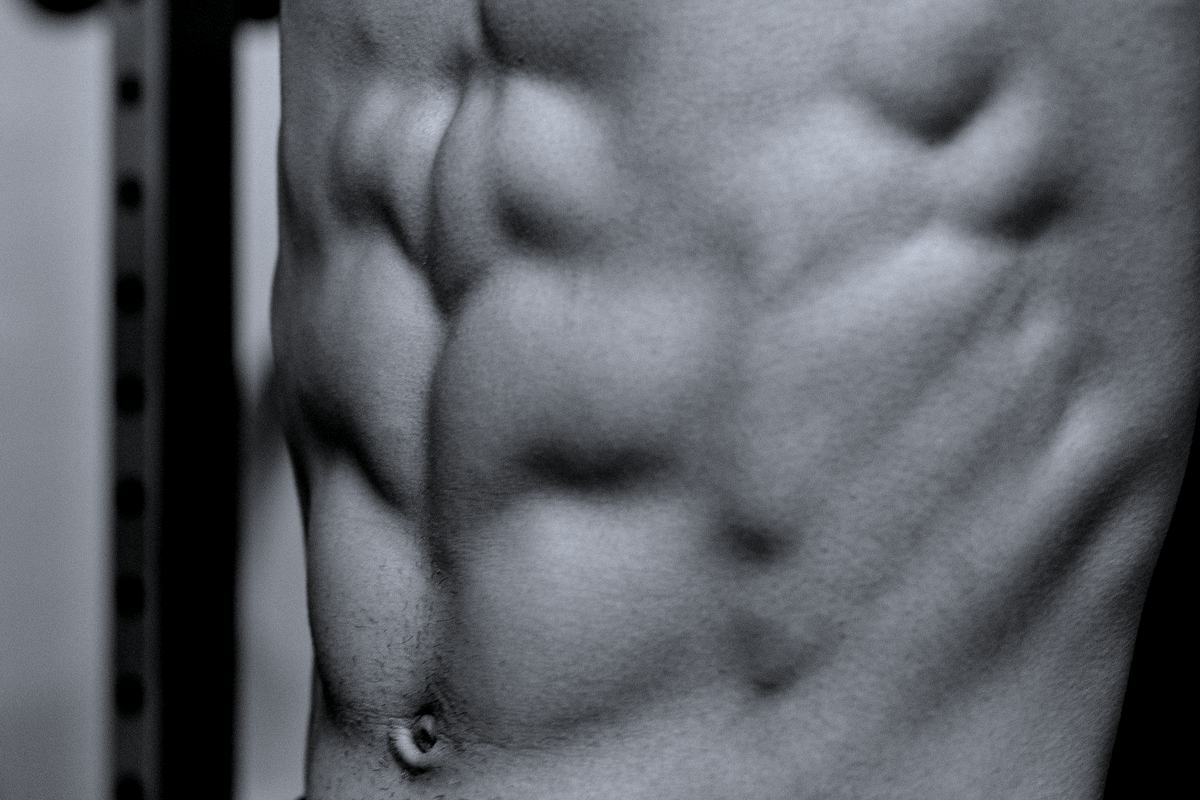
So the usable version, stated as what it is: for most men the abdominal wall starts to read somewhere in the low teens and is unambiguous below 10%. For most women that band sits roughly eight to ten points higher. Those are working ranges from practice, not findings, and the next two sections are why they have to be ranges.
Where your fat sits is not a training decision
Fat is not distributed evenly and it does not come off evenly, and the pattern is substantially decided before you ever pick up a barbell.
Karastergiou and colleagues review the biology of this in some detail. The differences between abdominal fat and the gluteal-femoral fat that predominates in many women are not just a matter of where the cells happen to be. The fat cells themselves differ in size, in metabolic behaviour, and in how readily their precursors multiply and mature. Sex steroids modulate it, the local environment of each depot modulates it, and some of the difference appears to be intrinsic to the cells rather than imposed on them.
The practical consequence is that “12% body fat” describes a total, and two people can arrive at the same total with very different amounts of it sitting across the abdominal wall. Even the total is not a simple function of size: Gallagher and colleagues’ equations for predicting body fat need sex, age and ethnic group as inputs alongside BMI, because the same BMI carries different amounts of fat in different bodies. Their equations predict the total only — where it sits is Karastergiou’s half of the problem, and nobody has an equation for it.
You cannot choose where you lose it from. You can only keep going until the place you want it gone from has run down, which for some people means going several points leaner than the number they read online.
Your body fat number has a wider error bar than you think
There is a second reason the same percentage looks different on different people, and it is duller: a lot of those percentages are wrong.
Gallagher and colleagues built their prediction equations against reference methods — four-compartment models and DXA — on 1,626 adults across three ethnic groups. Even with good reference data and the right variables in the model, the standard errors of the estimate ranged from 2.8 to 5.4 percentage points of body fat.
Be precise about what that number is: it is the error of a prediction equation built against reference-grade data, not the error of a bathroom scale. Gallagher says nothing about consumer devices, and there is no equivalent figure to hand you for one. But an equation with the right variables and a 1,626-person reference dataset behind it is the optimistic case — and a scale that sends a small current through your feet, or a caliper reading taken by someone who has done it twice, is not beating the optimistic case.
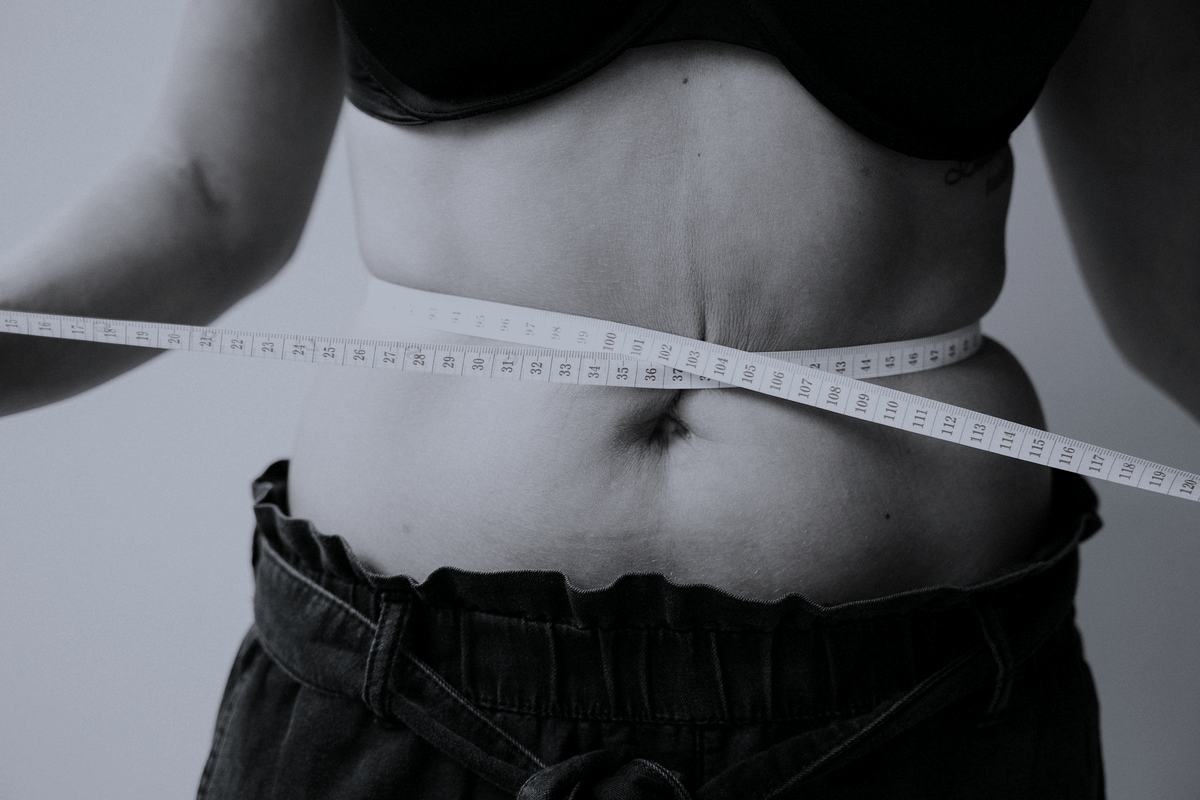
So treat any body fat percentage as a trend instrument, not a measurement. The same scale, at the same time of day, over eight weeks, will tell you honestly whether the number is going down. It will not tell you that you are at 13.2%.
Waist circumference at the navel, taken weekly on the same morning, is cheaper and more repeatable than most of the alternatives, and it moves in the direction you care about.
There has to be something under the fat
The rectus abdominis is a muscle. It responds to load, progression and a rep range like every other muscle, and if it is thin, then getting lean reveals a thin one.
This is the half of the “you cannot spot-reduce” argument that people drop. Vispute and colleagues took twenty-four sedentary volunteers and had one group perform seven abdominal exercises, two sets of ten, five days a week for six weeks, against a control group doing nothing, with diet held constant. The result everyone quotes: no change in body weight, body fat percentage, android fat, abdominal circumference or the abdominal skin folds. Crunches do not remove abdominal fat.
The result almost nobody quotes is in the same paragraph: the training group significantly improved abdominal muscular endurance. The training did something. It simply did not do the thing it was being sold for.
Train the abdominals the way you train everything else: loaded, twice a week, in a rep range you are progressing through, rather than as a high-repetition finisher you stop counting halfway. Weighted crunches, cable work, hanging leg raises, loaded carries. Fifteen minutes a week is enough if the load goes up.
And the fat still only comes off one way
None of the above changes the mechanism. Body fat falls when energy intake sits below energy expenditure for long enough, and every other variable on this page is about protecting muscle and adherence while that happens.
The practical sequence, then, is unglamorous and short:
- Establish the deficit and defend the muscle. That is the whole content of the twelve-week plan — up to about 500 calories a day, which is a ceiling rather than a target, 2 g of protein per kilogram, load held, volume trimmed.
- Train the abdominals like a muscle group, not like cardio. Loaded, twice a week, in a rep range you are progressing through.
- Track the trend, not the reading. Same instrument, same conditions, eight weeks minimum before you conclude anything.
- Expect it to take longer than the number suggests, because the last few percentage points come off the place you want them gone from last. The arithmetic for how long is worth doing before you start rather than in week six.
The single most useful reframe: stop asking what percentage abs show at, and start asking how many percentage points you are from wherever your body starts giving them up. Those are different questions, and only the second one has an answer that applies to you.
Where this comes from
The 26-week contest preparation with monthly DXA — 88.6 kg at 17.5% body fat down to 73.3 kg at 7.4% — is Kistler, Fitschen, Ranadive, Fernhall and Wilund, International Journal of Sport Nutrition and Exercise Metabolism, 2014 (doi:10.1123/ijsnem.2014-0016).
The twelve-month case study running 14.8% to 4.5% and back is Rossow, Fukuda, Fahs, Loenneke and Stout, International Journal of Sports Physiology and Performance, 2013 (doi:10.1123/ijspp.8.5.582).
The biology of depot differences between abdominal and gluteal-femoral fat, and the role of sex steroids and intrinsic cell properties: Karastergiou, Smith, Greenberg and Fried, Biology of Sex Differences, 2012 (doi:10.1186/2042-6410-3-13).
The body fat prediction equations, their inputs and their standard errors of 2.8 to 5.4 percentage points: Gallagher and colleagues, American Journal of Clinical Nutrition, 2000 (doi:10.1093/ajcn/72.3.694).
The abdominal training trial — no change in abdominal fat, improved abdominal endurance: Vispute, Smith, LeCheminant and Hurley, Journal of Strength and Conditioning Research, 2011 (doi:10.1519/JSC.0b013e3181fb4a46).
The 500-calorie deficit ceiling referenced in the closing sequence: Murphy and Koehler, Scandinavian Journal of Medicine & Science in Sports, 2022 (doi:10.1111/sms.14075).
Questions people ask about this
- What body fat percentage do abs show at?
- There is no measured answer, because no study has ever rated abdominal visibility against a body fat percentage. In practice, most men start to see the abdominal wall somewhere in the low teens and see it clearly below 10%, and most women see it roughly eight to ten points higher. Where you personally land inside that band is decided by how much of your fat sits on the abdomen, which is not something you choose.
- Why can I see my abs on some days and not others?
- Because a body fat percentage is a monthly-scale quantity and the things that change how you look are daily ones — glycogen and the water stored with it, gut contents, sodium and fluid shifts, and the lighting. None of those are fat. Judge the direction over eight weeks with the same instrument in the same conditions.
- Do ab exercises burn belly fat?
- Essentially no. Twenty-four sedentary volunteers doing seven abdominal exercises five days a week for six weeks changed their body fat percentage, android fat, waist circumference and abdominal skin folds by nothing measurable. The trials that do find a local effect find a small one, and it arrives with the energy expenditure rather than instead of it.
- Should I train abs at all?
- Yes, but as a muscle rather than as cardio. The rectus abdominis responds to load like anything else — in professional tennis players it is 58% larger by MRI volume than in non-active controls. Loaded work twice a week in a rep range you are progressing through decides whether there is anything worth uncovering when the fat comes off.